This website uses cookies to ensure that you have the best possible experience when visiting the website. View our privacy policy for more information about this. To accept the use of non-essential cookies, please click "I agree"
DismissI agree
The Talking Forest Runes
Coming Together
Yule 2024
by Kay Broome
Christmas Village Square (photo: Hert Niks)
Christmas is celebrated on December 25th
(or, in the Orthodox Church, January 7th). Hannukah is on the 24th
of the Hebrew month of Kislev, usually in late November or in December. Likewise, the dates for Muslim Eid vary as
well, but it often occurs in early winter. The Chinese New Year is the second
new moon after the winter solstice, and can be anywhere from mid-January to
mid-February. In the Pagan community, we
have Yule, celebrated on the winter solstice, on or around the 21st
of December.
Christmas is for Kids (photo: Chris Benson)
Light in the Darkness
From all the above we see a common theme: most cultures in the northern
temperate zone hold a big festival sometime in mid-winter. Certainly, during
this darkest time of the year, we need to create a special occasion during
which we can affirm each other and celebrate the fact we are still here; a time
to be grateful for what we have, and hopeful for spring that will eventually
come. Frequently, we celebrate by banqueting together, telling stories,
giving gifts and by singing songs that are specific to the season.
The western Christmas tradition was strongly influenced by various pagan
celebrations of mid-winter. These
festivities all included a large feast where the whole community was
involved. In earlier times, famine and
extreme cold were always a threat and not everyone would make it through the
harsh winter. The very young, the old and the sick were especially at risk, so
it was important to celebrate with them in case they were not around by spring.
To this day, whether we celebrate Christmas, Hannukah, Eid, the winter solstice, etc., it is necessary to come together and gift
each other with warmth and community spirit, especially now in these dark
times.
The Hemlock that Does Not Poison
Hemlock Tree in High Park, Toronto (photo: Kay Broome)
Unless you live on North America’s west coast, in Japan or elsewhere on Asia’s eastern
rim, you may not be familiar with the tree known as hemlock. Tsuga prefers cool, temperate
rainforests over the harsher cold of the boreal forests. In Europe, hemlocks died
out during the last ice age and were only reintroduced there as ornamentals in the 19th
century.
The hemlock tree has nothing to do with Socrates’ plant, the water parsnip (Conium
maculatum), actually a herb much like Queen Anne’s lace. The tree apparently
got its name from the scent of the needles, which are said to smell much like
the leaves of the plant that allegedly killed the famous
Greek philosopher. Tsuga hemlock however, is not poisonous. Nevertheless, woodland
novices should avoid using the needles to make tea, as they could mistake this
conifer for the yew, which is deadly poisonous.
Conium Maculatum, aka Water Parsnip (photo: Karelj from Charles University, Prague)
Hemlock is a beneficial tree within the forest. It regulates water flow and
quality, renders dense shade to help insulate the biome and provides shelter
for many animals. On the west coast of North America, hemlocks often
grow from logs and dead trees, thus helping to break down dead vegetation and
to create the dense, rich soft soil for which this region is so famous.
Hemlocks in Vancouver, BC (photo: Kay Broome)
A Tree of the Deep Forest
Hemlock is capable of living with hardly any sunlight, as a recent study
showed. Young hemlocks were seen thriving in the depths of a forest with
minimum light. Research later found that these
small conifers were receiving enough nutrients from birches and alders growing
quite a distance away in a sunnier part of the forest. This was due to the
relationship trees have with mycelium.
Mycelium, Commanster, Belgium, (Photo: James Lindsay)
The Interconnected Forest
Mycelium is the root-like structure of fungi and it differs in shape and appearance from species to species.
Generally, it is mat-like, interlacing itself among the roots of trees.
Mycelium is crucial to the life of a forest, helping to break down soil, to
transmit nutrients and to aid in the process of decomposition. This fungal root
structure is ubiquitous to the soil and indeed trees cannot live without it.
Mycelium helps send water and nutrients to tree roots and in turn is
fed by sugars obtained from the trees. It also connects trees with each other,
so that larger, taller specimens, capable of obtaining sunlight and rainwater
directly, can transmit these life-giving elements to smaller trees and saplings
that stand within their shade.
Hemlock Branches, High Park, Toronto (photo: Kay Broome)
Hemlocks enjoy the company of other trees, cheerfully growing within conifer
and deciduous woodlands alike, cohabiting with such diverse species as spruce, tuliptree,
beech, oak and maple.
Generally pyramidal in shape, hemlock looks somewhat like its
cousins fir and spruce, however, its needles are shorter and softer to
the touch. The branches, including the leader or main central branch, bend
at the tips, giving the tree the appearance of a hoary wizard with tall
drooping hat. Often asymmetrical, the tree
has a graceful, yet elderly mien. The cones are like those of spruce, but
smaller, growing only on the tips of the branches.
Hemlock Cones (photo: Kay Broome)
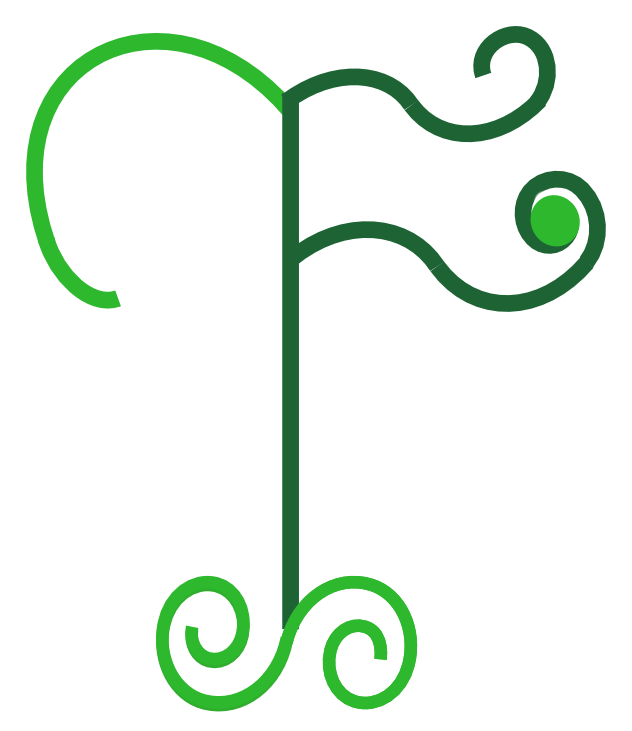
The Talking Forest Hemlock is asymmetrical, with the apex of the stem curving left, to mimic the bending of the leader branch of the tree.
There are two sweeping branches on the right, each with an oval at the tip
representing the cones of the hemlock tree. The kennings for this Talking Forest key are Sage or Elder.
This rune denotes the graciousness, wisdom and acceptance of
old age. Hemlock instructs us that our elders are important to us – they pass
on the knowledge and wisdom gained from their long lives. They include our
grandparents and aunts and uncles who helped raise us. The gentle bending of Hemlock instructs us to accept the changes that are inevitable with time. The lesson of this Talking Forest key
is to surrender graciously to age, allowing younger generations to do the active, hard work, while providing wise counsel and understanding from our vast experience. The elders possess the long backdrop of history; they can relate many tales of earlier times. Like the hemlock tree standing within the
mixed forest, elders can help to bring the tribes together to celebrate our differences
and our commonality. This celebration is needed most at the winter solstice, when we provide a light in the darkness and shelter from the cold.
Talking Forest Hemlock Rune
To learn more about Hemlock and the rest of the Talking Forest runes, you can purchase my book, available internationally in print or ebook on Amazon.